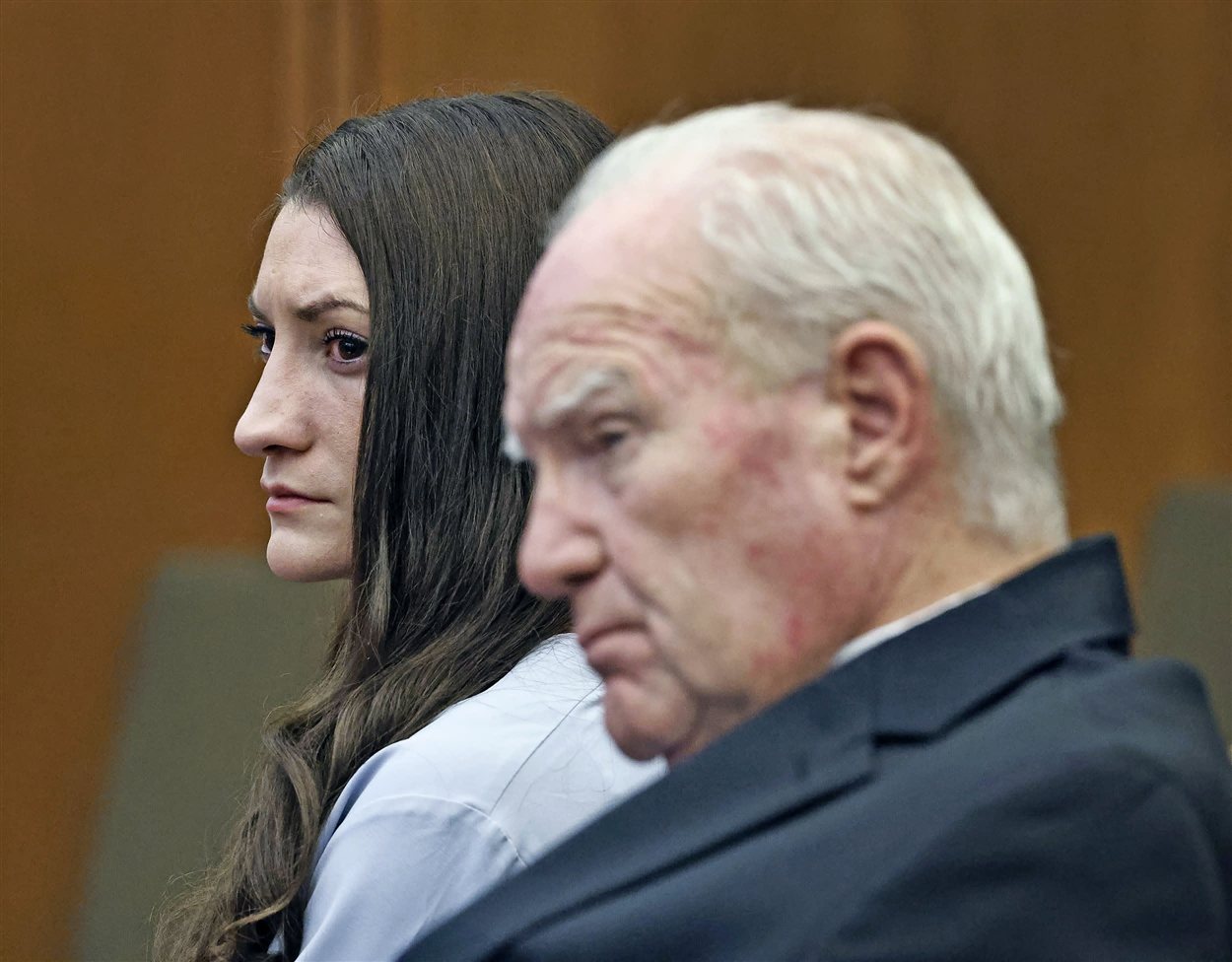
Plymouth Superior Court, September 1, 2026
Four days into deliberations, the Lindsay Clancy jury sent Judge William Sullivan a note saying what half of legal Twitter had already called: they can't agree.
Sullivan did the thing judges always do the first time they hear it. Told them to go back in there and keep working. Reminded them they'd sat through 80-plus witnesses and had 300-something exhibits waiting in that room. Then he shut the door on them again.
So what happens if they come back out and say it a second time? Here's the whole thing in order, and what each step does to Clancy's life. Not the vibes version. The mechanics.
What they're stuck on
Clancy is 36, a former labor and delivery nurse from Duxbury, charged with three counts of first-degree murder in the January 2023 deaths of her kids. Cora, five. Dawson, three. Callan, eight months.
She has never said she didn't do it. That is not what this jury is fighting about. They're fighting about whether she was criminally responsible when she did. The defense is postpartum psychosis. The Commonwealth's position is that she was depressed, sick of her own life, and made a decision.
Sullivan handed them five options:
- Guilty of first-degree murder
- Guilty of second-degree murder
- Guilty of manslaughter (which Sullivan added to the list right before sending them out)
- Not guilty
- Not guilty by reason of lack of criminal responsibility
Two things about that list. Number five is the insanity verdict, and Massachusetts words it that way on purpose, which we'll get to. And number four, plain not guilty, has apparently short-circuited people's brains. It's on there because it is always on there. The state has to prove its case. If it doesn't, that's your answer. That's not a loophole. That's the whole point of the machine.
The part cable news gets backwards every single time
The defense does not have to prove she was insane. The Commonwealth has to prove she was sane.
Once lack of criminal responsibility is properly on the table, and five weeks of psychiatric testimony absolutely put it there, the burden belongs to the prosecution. They have to prove beyond a reasonable doubt that Clancy either wasn't seriously mentally ill, or that she was but still understood what she was doing was wrong, or could have stopped herself and didn't.
Massachusetts uses the substantial capacity test. You're not criminally responsible if mental illness took away your substantial capacity to either appreciate that what you're doing is wrong or to control yourself. A diagnosis doesn't get you there. A severe diagnosis doesn't get you there. The illness has to have eaten that specific capacity, that specific day, that specific hour.
Which is a wildly narrow thing to prove or disprove three and a half years after the fact, using experts who never laid eyes on the woman that day and built their conclusions out of a paper file. Two of them read the same file and came out opposite. That is where this jury is stuck.
Nobody should be shocked they're stuck
Look at what these twelve people (nine women, three men, make of that what you will) are hauling around:
- A five-week trial
- More than 80 witnesses
- Several hundred exhibits, including dense medical records and digital evidence
- Two psychiatric experts who reached opposite conclusions from identical material
- Five possible verdicts, several with their own internal sub-questions
- Four months of escalating psychiatric prescriptions, repeated attempts to get help, and a psychiatric hospitalization, all before the killings
- An instruction from the bench that they may consider what those prescriptions did to her
On Friday they sent their first note, asking for her pill bottles and the physical evidence from her suicide attempt. That is not a jury coasting. That's a jury going straight at the mental state question with both hands.
They deliberated roughly 17 hours over three days before saying they were stuck. For a trial this size, that is nothing. That's twelve people running headfirst into a question that is hard on the merits.
Step one: go back in there
This is where we are right now. When a jury says it can't agree, the bench does not go straight to mistrial. Ever. The first move is always some flavor of try again, and Sullivan made it Tuesday morning with a pointed reminder about how much material they still hadn't worked through.
None of this is dramatic. Juries get stuck and then unstick themselves constantly. You will be told otherwise all week by people who have nine hours of airtime to fill.
Step two: the dynamite charge
If they come back and say it again, Sullivan has exactly one move left, and it has the best name in criminal procedure. Formally it's the Tuey-Rodriguez instruction. Everybody else calls it the dynamite charge, because the entire point of it is to blow a deadlock open.
Tuey is an 1851 Massachusetts case. Rodriguez is a 1973 SJC decision that rewrote the language to be less coercive. What it tells jurors, roughly: you are not going to get a smarter or fairer twelve people than the ones in this room, another jury will just have to do all of this over again, so go back and ask yourself whether you're holding a real conviction or whether you've simply stopped listening.
It's controversial as hell. Several states banned their versions of it outright on the theory that it leans on holdouts until they fold. Massachusetts kept it and built a fence around it. Judges stay close to the script and don't freelance. Specifically, a judge is not allowed to bring up what a retrial would cost, because that's a thumb on the scale and everyone in the room knows it.
If you've been anywhere near a Massachusetts courtroom in the last two years you've watched this movie. Judge Cannone gave the Karen Read jury the same instruction in 2024. It did not work.
Stuck on one count is not a hung jury
Here's the distinction that gets bulldozed in nearly every writeup of this case.
Massachusetts juries work down the ladder. If they've unanimously agreed she isn't guilty of first-degree but they're split on second, that is not a hung case. That's a partial verdict, and it is enormous, because an acquittal on a count is permanent. Double jeopardy attaches. She can never be tried on it again.
Which brings us to the ugliest footnote in recent Massachusetts legal history. After the Karen Read jury hung and Cannone declared the mistrial, jurors came forward and said they'd unanimously agreed to acquit on two of the three counts. They just didn't know they were allowed to say so out loud. Nobody told them. It never got reported in open court, so legally it never happened, and she got retried on all of it.
So if the Clancy foreperson tells Sullivan they have agreement on some counts and not others, watch like a hawk whether those findings get formally returned and recorded. That isn't paperwork. That's somebody's whole life riding on whether twelve exhausted people know the right thing to say out loud.
Step three: mistrial
If the dynamite charge fails and the jury reports itself hopeless, Sullivan declares a mistrial.
The doctrine underneath is manifest necessity. A judge can pull the plug when continuing has become impossible, and a hopelessly deadlocked jury is the textbook version of that. Because the mistrial comes from necessity and not from prosecutors fumbling the case, double jeopardy does not block a second trial.
Slowly, for the people in the back, because this is where the internet loses its mind every time: a mistrial is not an acquittal. It's not a win for anybody. It's a null. The case snaps back to where it stood before opening statements, and those indictments are still sitting right where she left them.
What happens to her that day
She's still a defendant facing three counts of first-degree murder. Custody status reverts to whatever the court orders while she waits. Her legal exposure doesn't improve by a millimeter. Everybody goes home and starts over.
Would Plymouth County run it back?
That's the district attorney's call, not the judge's. What goes into it:
- How lopsided the split was. DAs find out by interviewing jurors afterward. Eleven to one for conviction is a completely different conversation than six to six, or eleven to one the other direction.
- Where it broke. If they were fighting over first versus second degree, that's a signal to retry with the charges adjusted. If they were fighting over criminal responsibility itself, the whole theory is in trouble.
- The bill. Five weeks, 80-plus witnesses, multiple retained psychiatric experts. Nobody runs that back casually.
- What the family wants. Clancy's husband, the children's father, has been publicly supportive of her. A DA deciding whether to put a grieving father through this twice is not making a purely legal decision.
- Whether the experts survive round two. Both sides now have a complete map of the other's case. That cuts in both directions.
Norfolk County retried Karen Read. Eleven months from mistrial to second verdict, and it ended in acquittal on everything serious. That outcome is sitting in the back of every prosecutor's skull in this state right now.
And if they do come back with a verdict
Since the deadlock coverage has completely buried what's on the table:
First-degree murder. Mandatory life, no parole, ever. Automatic appeal to the SJC as a matter of right.
Second-degree murder. Life, but parole eligible. The judge sets a minimum somewhere between 15 and 25 years.
Manslaughter. Up to 20 years in state prison.
Not guilty by reason of lack of criminal responsibility. Everybody gets this one wrong, so read it twice. She does not walk out the door. Under Massachusetts General Laws chapter 123, section 16, the court can order her hospitalized up to 40 days for observation. Inside that window the DA or the facility superintendent can petition to commit her. If the court grants it, that's six months locked in a Department of Mental Health facility. (Bridgewater, the maximum-security option, is men only by statute.) After six months it renews in one-year increments, indefinitely, as long as she still meets the standard. Nationally, people found not guilty by reason of insanity frequently do more time than they would have served on a conviction. So the "she gets away with it" take is bullshit. The verdict doesn't end state custody. It changes which door she walks through.
Not guilty. She's released. Even then a judge can order an evaluation and pursue civil commitment if she's found to be a danger.
Reality check
Forget the procedure for a second.
Twelve people spent the better part of a week trying to answer a question the law is not built to ask. Not "did she do it." Nobody is arguing about that. Not "was she sick." The medical record screams about that. The question is whether one specific illness destroyed one specific mental capacity at one specific hour on one specific January night in 2023, and whether the Commonwealth can disprove that beyond a reasonable doubt using two experts who read a file years later and walked away with opposite answers.
Of course they're stuck. That isn't a jury failing. That's the system handing you a receipt.
And look at where every bit of this is happening. In a courtroom. Afterward. The four months of escalating prescriptions, the help she went looking for, the psychiatric hospitalization she'd already been through, all of it finally got assembled into one coherent record. It took three dead children to do it.
Postpartum psychosis is rare. It is also a recognized psychiatric emergency with a known onset window. We know how to screen for it. We mostly don't, not in any way that survives a hospital discharge, a handoff between providers, and a follow-up appointment nobody scheduled.
So we spend a fortune litigating criminal responsibility on the back end and close to nothing catching it on the front end. Then we stand around looking stunned when twelve reasonable people can't agree on what to do with the wreckage.
What to watch
- What's in the next jury note. Questions about the difference between the degrees means they're fighting over what to convict on. Questions about the criminal responsibility standard means they're fighting over whether to convict at all.
- Whether Sullivan gives the formal Tuey-Rodriguez charge, and whether Reddington objects to how he words it. That objection is how you preserve an appellate issue.
- Whether the foreperson reports agreement on any single count. If they've acquitted on something, it has to be returned and recorded in open court or it evaporates. See above. See Karen Read.
- How fast the Plymouth DA says something after a mistrial. Fast and firm means the split favored them. Silence and "we're reviewing our options" means it didn't.
More on the show as this develops.
If you or someone you know is struggling, you can call or text 988 to reach the Suicide and Crisis Lifeline. For postpartum mental health support, Postpartum Support International runs a helpline at 1-800-944-4773.